
Making a star means compressing gas by something like twenty-four orders of magnitude. The warm neutral interstellar medium, the ordinary atomic gas between the stars, holds roughly a third of a hydrogen atom per cubic centimetre at a temperature of several thousand kelvin, which puts its density near $10^{-24}$ grams per cubic centimetre. The mean density of the Sun is $1.41$ grams per cubic centimetre. The Galaxy takes material from one end of that range and pushes it to the other, currently at a rate of one or two solar masses per year, and it has been doing so for most of its life. The question is what makes a patch of thin interstellar gas stop being gas and become a star.
Gravity is the only force available that can gather matter over large distances, and it has to compete with pressure. Pressure doesn’t know in advance that a cloud is trying to collapse. It reacts to compression by launching sound waves. So the first question is a race: can gravity make a density enhancement grow faster than pressure can communicate across it and smooth it away? Jeans turned that into an equation in 1902.
Take an isothermal self-gravitating fluid, $$\frac{\partial\rho}{\partial t}+\nabla\!\cdot(\rho\mathbf{v})=0, \qquad \frac{\partial\mathbf{v}}{\partial t}+(\mathbf{v}\cdot\nabla)\mathbf{v}=-\frac{\nabla P}{\rho}-\nabla\Phi, \qquad \nabla^{2}\Phi=4\pi G\rho,$$ with $P=c_s^{2}\rho$. Take a uniform static background of density $\rho_0$, perturb it as $\rho=\rho_0+\rho_1$, $\mathbf v=\mathbf v_1$, $\Phi=\Phi_0+\Phi_1$, and keep only terms first order in the perturbations.1There is a genuine inconsistency hidden here, traditionally called the Jeans swindle. An infinite medium with constant density cannot simultaneously satisfy $\nabla^2\Phi_0=4\pi G\rho_0$ and have no background gravitational acceleration. The usual calculation ignores the gravity of the uniform background and keeps the gravity of the perturbation. More careful treatments using finite systems or expanding backgrounds recover essentially the same instability criterion, so the answer survives even though the original setup is not mathematically self-consistent.
Differentiate the continuity equation with respect to time, take the divergence of the momentum equation, and use Poisson’s equation to eliminate $\Phi_1$. The three equations become one, $$\frac{\partial^{2}\rho_1}{\partial t^{2}}-c_s^{2}\nabla^{2}\rho_1-4\pi G\rho_0\rho_1=0,$$ and looking for a plane wave $\rho_1\propto\exp[i(\mathbf k\cdot\mathbf x-\omega t)]$ collapses the whole problem to $$\omega^{2}=c_s^{2}k^{2}-4\pi G\rho_0.$$
Take the terms one at a time. Without gravity this is $\omega=c_sk$, an ordinary sound wave. Gravity subtracts the same amount from $\omega^2$ at every wavelength, while pressure’s contribution grows as $k^2$ and so becomes increasingly effective on small scales. At large $k$, meaning short wavelengths, pressure wins, $\omega^2>0$, and the perturbation oscillates. At small $k$ gravity wins, $\omega^2<0$, $\omega$ becomes imaginary, and one of the two solutions grows exponentially.
The boundary sits at $k_J=\sqrt{4\pi G\rho_0}/c_s$, or in wavelength $$\lambda_J=\frac{2\pi}{k_J}=c_s\sqrt{\frac{\pi}{G\rho_0}}.$$ In this idealised medium, perturbations larger than $\lambda_J$ are gravitationally unstable and smaller ones behave like sound waves. Real molecular clouds are neither uniform nor static nor unmagnetised, so $\lambda_J$ shouldn’t be treated as a sharp boundary in nature. What survives is the competition it exposes: pressure grows stronger on small scales, while self-gravity doesn’t weaken when you look at a larger piece of gas.
Turning the Jeans length into a mass gives the more useful quantity. Taking a sphere whose diameter is $\lambda_J$, $$M_J=\frac{4\pi}{3}\rho_0\left(\frac{\lambda_J}{2}\right)^{3}=\frac{\pi^{5/2}}{6}\frac{c_s^{3}}{G^{3/2}\rho_0^{1/2}}\approx2.9\,\frac{c_s^{3}}{G^{3/2}\rho_0^{1/2}}.$$ The prefactor matters less than the scaling, $M_J\propto c_s^3\rho^{-1/2}\propto T^{3/2}\rho^{-1/2}$, and you can recover that scaling without any perturbation theory at all. The only combination of $G$, $c_s$ and $\rho$ with units of mass is $c_s^3G^{-3/2}\rho^{-1/2}$. The full calculation tells you why that combination matters and supplies the numerical factor.
Put in numbers for a cold dense core. Molecular gas with helium has a mean molecular weight $\mu\simeq2.33$, so at $T=10$ K the sound speed is $c_s=\sqrt{k_BT/\mu m_H}\simeq0.19\ \mathrm{km\,s^{-1}}$. At $n=10^4\ \mathrm{cm^{-3}}$ this gives $\lambda_J\simeq0.21$ pc and $M_J\simeq2.9\,M_\odot$. A few solar masses spread over a few tenths of a parsec isn’t an absurd theoretical scale. It’s close to the scale of the dense structures actually found inside nearby molecular clouds.
The temperature dependence matters even more. Since $M_J\propto T^{3/2}$, going from $8000$ K to $10$ K lowers the characteristic unstable mass by $(800)^{3/2}\approx2\times10^4$. Warm diffuse gas is very hard to make gravitationally unstable on stellar mass scales, and cold gas is much easier, which ties star formation directly to cooling.
The details are a little more interesting than saying gas must become molecular in order to cool. Atomic species such as ionised carbon cool neutral gas efficiently, and molecular hydrogen is not always the dominant coolant in ordinary Galactic molecular clouds. What really matters is shielding from the interstellar ultraviolet field. Once enough column density builds up, photoelectric heating weakens, molecules survive, dust becomes cold, and temperatures near $10$ K become possible. Becoming cold and becoming molecular happen together, though one is not simply the cause of the other.
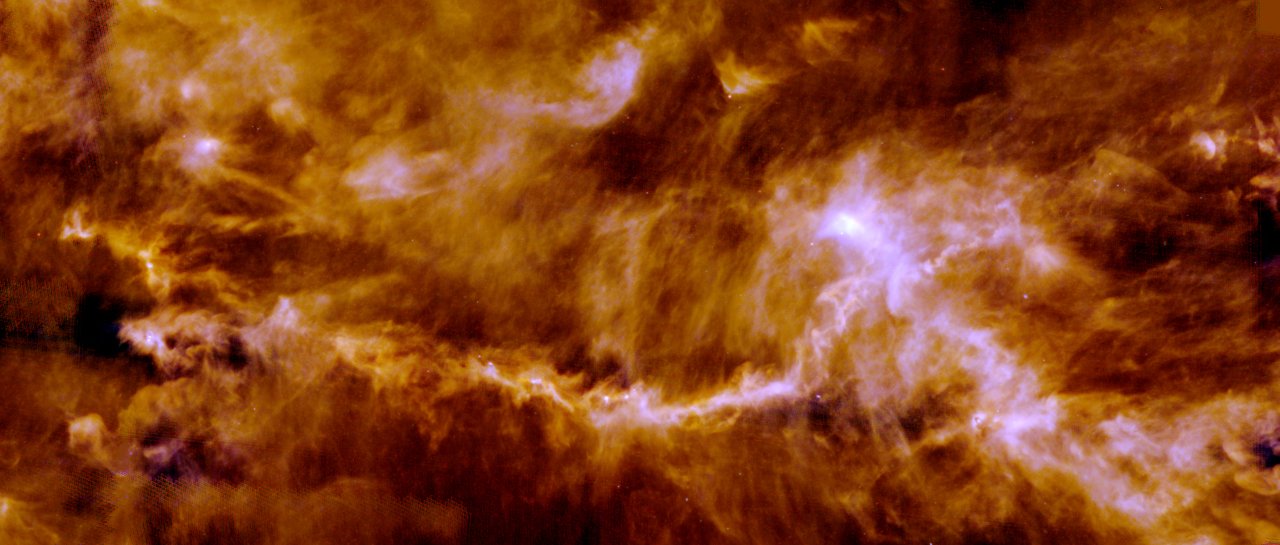
There’s another way to phrase the same stability problem that sits closer to what an observed core actually looks like. A real core is finite and can be confined by the pressure of the gas around it, and an isothermal pressure-confined sphere has a maximum stable mass, the Bonnor-Ebert mass, $$M_{\rm BE}\simeq1.18\,\frac{c_s^{4}}{G^{3/2}P_{\rm ext}^{1/2}}.$$ Above that, no hydrostatic configuration exists for the assumed temperature and external pressure. The details differ from the infinite-medium Jeans calculation, but the message is nearly the same. A cold enough and massive enough concentration of gas cannot find a pressure-supported equilibrium.
Suppose it crosses that line. Strip away pressure completely, start with a uniform sphere, and a shell at initial radius $r_0$ feels only the mass inside it, so $\ddot r=-GM/r^2$. Integrating once gives $\tfrac12\dot r^2=GM(1/r-1/r_0)$, and a further integration using $r=r_0\cos^2\xi$ gives the free-fall time $$t_{\rm ff}=\sqrt{\frac{3\pi}{32G\rho_0}}.$$ The radius has disappeared. For a uniform sphere the collapse time depends only on density, so every shell arrives at the centre together. At $n=10^4\ \mathrm{cm^{-3}}$ this is $0.34$ Myr, and at the more typical mean density of a molecular cloud, $n\simeq100\ \mathrm{cm^{-3}}$, about $3.4$ Myr.
Those numbers fail badly against observation. The Milky Way contains of order $10^9\,M_\odot$ of molecular gas, and if all of it turned into stars on a cloud free-fall time the star formation rate would be roughly $$\dot M_\star\sim\frac{M_{\rm mol}}{t_{\rm ff}}\sim\frac{10^9\,M_\odot}{3.4\ \mathrm{Myr}}\sim300\ M_\odot\,\mathrm{yr^{-1}}.$$ The real Galactic rate is around $1$ to $2\,M_\odot\,\mathrm{yr^{-1}}$, so the naive estimate misses by roughly two orders of magnitude.
A convenient way to write the discrepancy is the efficiency per free-fall time, $\epsilon_{\rm ff}\equiv\dot M_\star t_{\rm ff}/M_{\rm gas}$. On molecular-cloud scales the inferred values are of order one percent, often somewhere between $0.3$ and $3$ percent, with substantial scatter from cloud to cloud and through a cloud’s lifetime. The point isn’t that nature picked exactly $0.0100$. It’s that the answer is nowhere near unity, and something is preventing most molecular gas from falling straight in.3The low value of $\epsilon_{\rm ff}$ is one of the central empirical constraints on star formation theory. Modern cloud-lifecycle work also makes clear that individual clouds need not form stars at a perfectly constant rate. A cloud can evolve through quiet and active phases, so an average value near one percent does not mean every cloud converts exactly one percent of its mass every free-fall time.
The usual bookkeeping device is the virial theorem. The full scalar version contains kinetic energy, gravitational energy, magnetic terms, surface pressure and time-dependent terms, but ignore most of those and approximate the cloud as a uniform sphere. Then $W=-\tfrac35 GM^2/R$ and $T=\tfrac32 M\sigma^2$, with $\sigma$ the one-dimensional velocity dispersion, and their ratio gives the virial parameter $$\alpha_{\rm vir}\equiv\frac{5\sigma^{2}R}{GM}.$$ For this simple model $\alpha_{\rm vir}=1$ corresponds to $2T=|W|$.
Values of order unity tell us kinetic and gravitational energies are comparable. They don’t prove a cloud is sitting in static equilibrium. A cloud can be accreting, contracting, losing material, confined by external pressure or threaded by a dynamically important magnetic field and still have an order-unity virial parameter. That matters because observed molecular clouds commonly have $\alpha_{\rm vir}$ of order one or a few. They aren’t behaving like cold pressureless spheres in free fall, but the virial parameter alone doesn’t tell us what they are doing.
The most obvious extra ingredient is turbulence. At $10$ K the sound speed is only $0.19\ \mathrm{km\,s^{-1}}$, yet molecular lines are routinely much broader than that, and the non-thermal dispersion increases with the size of the region measured. Larson identified this in 1981, and later CO surveys found relations roughly of the form $$\sigma_v\sim0.7\left(\frac{R}{1\ \mathrm{pc}}\right)^{1/2}\ \mathrm{km\,s^{-1}},$$ although neither the slope nor the normalisation is universal and surface density and environment both matter. Taken literally at $R=10$ pc it gives a few kilometres per second, more than ten times the sound speed of cold molecular gas.
Supersonic turbulence then does two things at once. It resists global collapse by supplying kinetic energy, and it also creates the structures that collapse first, because supersonic flows form shocks and shocks compress gas. In idealised isothermal turbulence without self-gravity the density distribution is approximately lognormal, and once self-gravity becomes important the densest collapsing regions develop a power-law tail. Those are the regions where the local Jeans mass becomes small and collapse runs ahead. Turbulence moves mass around, builds filaments and sheets, produces rare high-density regions and changes where gravity first gets to win, which is why many theories of the star formation rate begin by asking what fraction of a turbulent density field becomes gravitationally unstable.
Magnetic fields complicate the picture again, because a field doesn’t resist all compression equally. Gas moves much more easily along a field than across it, and under ideal flux freezing matter and flux move together, so the useful quantity is the mass-to-flux ratio $M/\Phi$. For a simple sheet-like geometry the critical value is of order $$\left(\frac{M}{\Phi}\right)_{\rm crit}\simeq\frac{1}{2\pi\sqrt G}, \qquad M_\Phi\simeq\frac{\Phi}{2\pi\sqrt G}\sim\frac{R^{2}B}{2\sqrt G}.$$ At $R=1$ pc and $B=10\,\mu\mathrm{G}$ that is about $93\,M_\odot$.
If a cloud is magnetically subcritical, the field can prevent collapse across the field lines in the idealised flux-frozen limit. If it’s supercritical, gravity is strong enough that the field can’t hold the cloud up forever on its own. That doesn’t make the field irrelevant, since a supercritical field can still change the geometry, the collapse rate, the fragmentation and the angular momentum of the gas.
Observationally the situation is messy. Zeeman splitting gives the line-of-sight field strength, dust polarisation gives the field orientation projected on the sky, and neither gives the full three-dimensional field without assumptions. The broad picture is that magnetic fields are dynamically important and that dense star-forming gas is generally not enormously subcritical. Exactly how close clouds and cores sit to the critical value is harder to establish than a single number makes it sound.
Flux freezing isn’t exact either. Molecular gas is only weakly ionised, so charged particles couple directly to the field while neutrals drift relative to them. This is ambipolar diffusion, and it lets matter move inward without dragging the full flux along, so the mass-to-flux ratio of a dense region can increase. For a long time slow ambipolar diffusion through a magnetically supported cloud was one of the standard explanations for inefficient star formation. It still matters, but that clean picture has been replaced by a mixed one in which turbulence, gravity, ambipolar diffusion, Ohmic dissipation, the Hall effect, accretion from the surrounding cloud and stellar feedback all operate somewhere in the problem, with the dominant one depending on density and environment.
Once a core does collapse, another idealised calculation becomes useful. A uniform sphere collapses everywhere at once because every shell shares a free-fall time, but real dense cores are centrally concentrated. The classic analytic model is Shu’s inside-out collapse of a singular isothermal sphere, which starts from $\rho(r)=c_s^2/2\pi Gr^2$. Once collapse begins at the centre an expansion wave moves outward at the sound speed, gas inside the wave falls inward, gas outside hasn’t yet responded, and the accretion rate is constant: $$\dot M=0.975\,\frac{c_s^{3}}{G}\simeq1.5\times10^{-6}\,M_\odot\,\mathrm{yr^{-1}}\quad(T=10\ \mathrm{K}).$$ A solar mass at that rate takes several hundred thousand years to assemble.
The scaling follows from dimensions again, since the only variables in the isothermal problem are $c_s$ and $G$ and the combination with units of mass per time is $c_s^3/G$. Warmer gas therefore has a much larger characteristic accretion rate. The number $0.975$ belongs to one very specific initial condition, though. Real cores don’t begin as exact singular isothermal spheres and real accretion isn’t constant. Simulations and observations both find time dependence, bursts and strong effects from rotation, magnetic fields and the surrounding environment. Shu’s solution is useful because it sets a clean scale, not because protostars follow it like a timetable.
The infalling material also doesn’t jump straight from molecular-cloud density to stellar density. At first the gas radiates away most of the energy released by compression, so the collapse stays close to isothermal. Eventually the central region becomes optically thick to its own infrared radiation, cooling can no longer keep up, the temperature rises, pressure stiffens, and collapse temporarily stops. A small hydrostatic object a few astronomical units across appears: the first hydrostatic core, predicted by Larson in 1969. Finding one has been much harder, since the phase is short-lived and deeply buried, and although several objects have been proposed, an unambiguous observational identification remains difficult.4Modern radiation-hydrodynamic calculations give a detailed picture of the first and second core stages, but the observational signature of a genuine first hydrostatic core is not unique. Several good candidates exist. It is safer to call them candidates than to say the phase has been securely observed as a class of objects.
The first core doesn’t survive. As its centre approaches roughly $2000$ K, molecular hydrogen begins to dissociate, and breaking an $\mathrm{H_2}$ molecule costs $4.48$ eV. Energy from compression now goes into dissociation instead of efficiently raising the temperature, the effective adiabatic index drops, pressure support weakens, and the gas enters a second collapse. That continues until most of the hydrogen in the centre has become atomic and the equation of state stiffens again. What’s left behind is the second hydrostatic core, which is what we normally call the protostar.
This change in thermodynamics also matters for fragmentation. While gas cools efficiently a collapsing region can keep breaking into smaller unstable pieces, and once it becomes opaque and starts heating rapidly, further fragmentation becomes much harder. That produces an opacity-limited minimum fragment scale. The exact mass depends on the thermodynamics, the rotation and the later accretion, so it shouldn’t be confused with a hard lower limit on the final mass of a brown dwarf. It is the first hint that microscopic physics can leave a preferred mass scale inside a problem that looked scale-free when we started with Jeans.
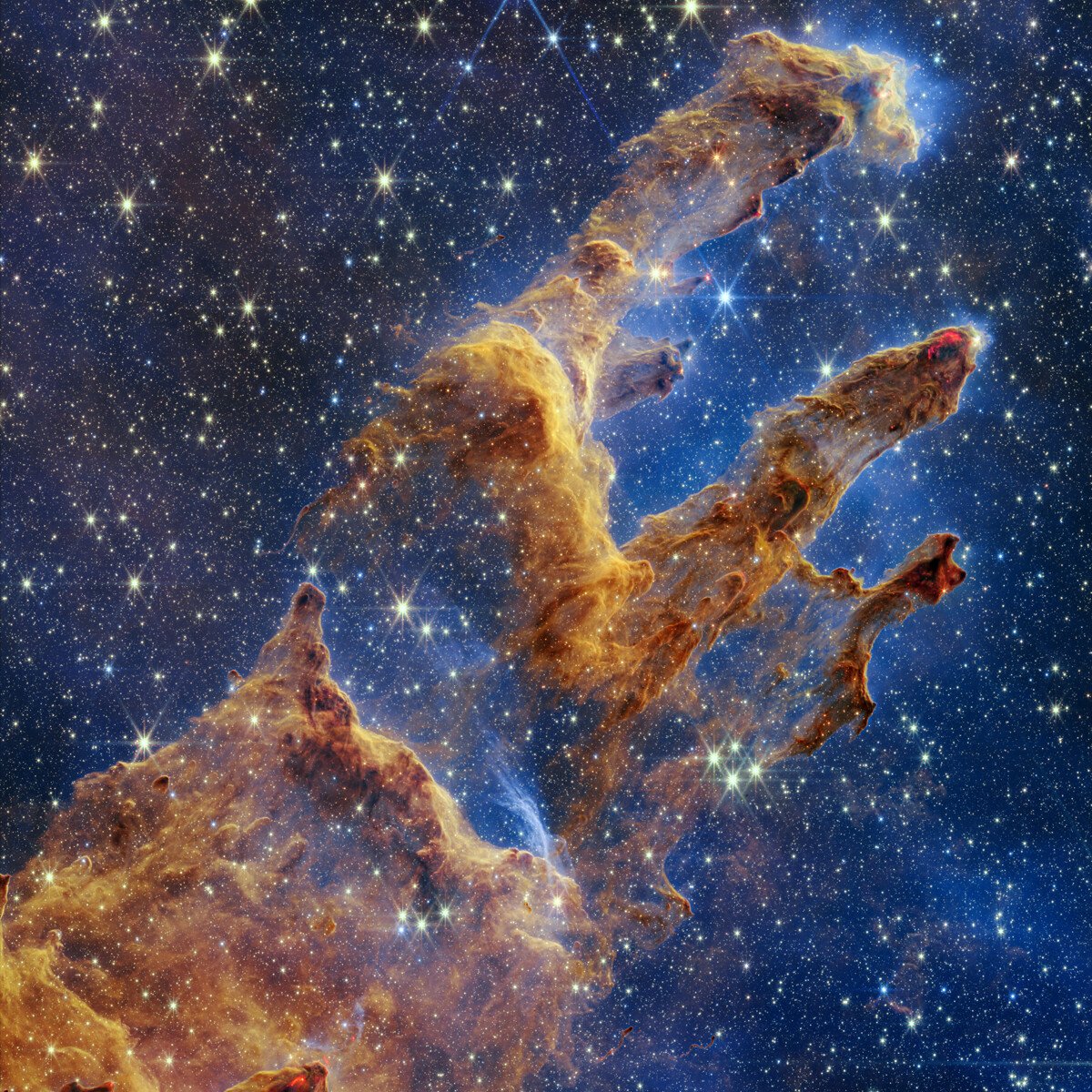
There’s another problem waiting for the collapsing gas, and it has nothing to do with whether gravity is strong enough. The gas rotates. A core with radius $0.1$ pc and a characteristic rotational speed of $0.1\ \mathrm{km\,s^{-1}}$ has a specific angular momentum of order $j_{\rm core}\sim Rv\sim3\times10^{21}\ \mathrm{cm^2\,s^{-1}}$, while the specific angular momentum actually stored in the Sun’s spin is only of order $10^{15}\ \mathrm{cm^2\,s^{-1}}$. The precise comparison depends on the internal rotation profile and on how you define the core’s rotation, but the mismatch is around six orders of magnitude, and angular momentum can’t simply be destroyed.
The first part of the solution is a disc. Gas with too much angular momentum to fall directly onto the centre reaches a centrifugal barrier and settles into rotation, with $\Omega(R)=\sqrt{GM_\star/R^3}$ for a Keplerian disc. Making a disc doesn’t solve anything by itself, because if every ring keeps its angular momentum forever the disc just sits there. For matter to move inward, angular momentum has to move outward.
Shakura and Sunyaev gave a way to describe that transport without knowing its cause, writing the effective viscosity as $\nu=\alpha c_sH$ with $H$ the disc scale height and $\alpha$ packaging the unknown physics into one dimensionless number. For years the most famous candidate for supplying it was the magnetorotational instability. Take two pieces of a differentially rotating disc and connect them weakly with a field line. The inner piece orbits faster, magnetic tension transfers angular momentum from the inner piece to the outer one, the inner piece falls further inward while the outer one moves further out, and the increased differential motion lets the instability grow.
The difficulty is that a protoplanetary disc isn’t an ideal conducting fluid. Much of it is cold and only weakly ionised, and Ohmic resistivity, ambipolar diffusion and the Hall effect all modify the magnetic coupling, suppressing vigorous MRI turbulence over large parts of the disc. The modern picture puts much more weight on magnetised disc winds, where large-scale fields threading the disc carry angular momentum vertically away from it and let gas accrete without strong turbulence throughout. MRI probably still matters in some regions and gravitational torques matter in young massive discs, but there’s no single universal $\alpha$ mechanism.6The history is worth noting. Velikhov and Chandrasekhar studied the instability decades before Balbus and Hawley recognised its importance for accretion discs in 1991, after which MRI became almost synonymous with angular momentum transport in disc theory. Non-ideal MHD changed that. Current work increasingly treats magnetic winds as a major and possibly dominant route for angular momentum loss in protoplanetary discs, with the balance between winds, MRI, hydrodynamic instabilities and gravitational torques depending on radius and evolutionary stage.
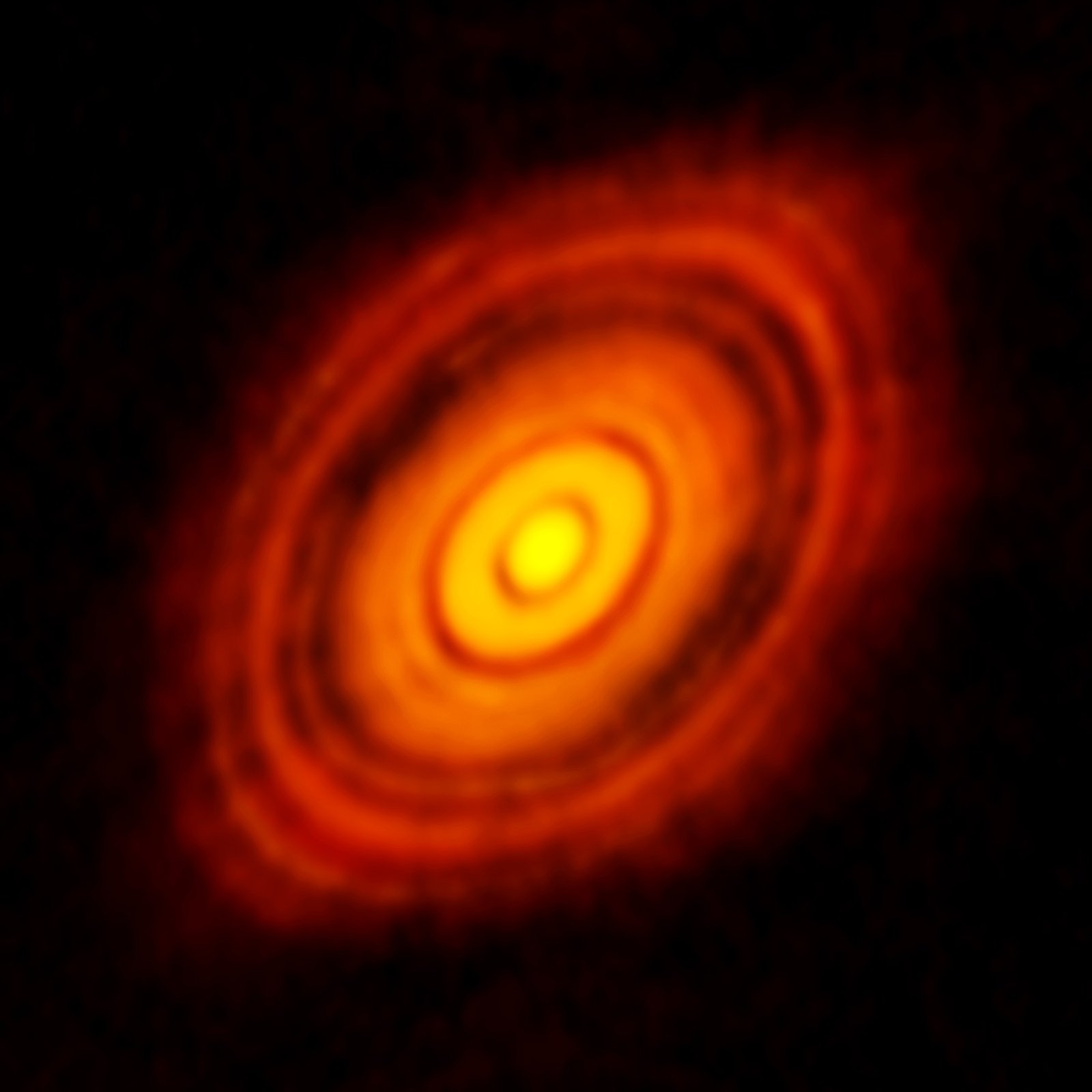
A young disc can also become gravitationally unstable on its own, and the disc version of the Jeans argument is Toomre’s criterion. For a thin gas disc with surface density $\Sigma$, sound speed $c_s$ and epicyclic frequency $\kappa$, define $$Q=\frac{c_s\kappa}{\pi G\Sigma},$$ with $\kappa=\Omega$ for a Keplerian disc. Axisymmetric disturbances become gravitationally unstable when $Q$ drops below order unity.
Instability doesn’t automatically mean fragmentation. A disc with $Q\sim1$ can develop spiral structure and use gravitational torques to transport angular momentum without breaking into separate objects. To fragment it also has to shed the heat generated by compression and shocks quickly enough, which is why disc thermodynamics matters as much as the value of $Q$. Young massive discs are therefore the most vulnerable, and if fragmentation does occur it can make stellar or brown-dwarf companions. Forming giant planets this way is possible in some parts of parameter space, especially at large radii, but it isn’t the inevitable outcome of $Q<1$.[mfn]A common way to express the cooling requirement is through $t_{\rm cool}\Omega$. Fragmentation is favoured when the cooling time is only a few orbital times or less, although the exact critical value is not universal and depends on the equation of state, irradiation and numerical setup.[/mfn]
The other half of the angular momentum story sits above and below the disc, where young stars launch jets and winds. The fastest collimated jets reach hundreds of kilometres per second and extend for parsecs, and their connection to accretion isn't an accident, because a magnetic field can extract angular momentum from rotating disc material and put it into an outflow. The cleanest toy model is Blandford and Payne's bead on a wire: take a field line anchored to the disc at radius $r_0$, pretend it's rigid, and force a parcel of gas to slide along it while rotating with the footpoint. In the rotating frame the effective potential is $$\Phi_{\rm eff}(r,z)=-\frac{GM}{\sqrt{r^{2}+z^{2}}}-\frac12\Omega_0^{2}r^{2},$$ and expanding it along the field line near the disc shows that if the line leans more than $30^\circ$ from the rotation axis the potential falls as you move outward along it.
Gas can then accelerate away from the surface without thermal pressure pushing it over a barrier. The wind doesn't get its energy for free: the energy and angular momentum come from the rotating accretion flow, and the magnetic field is the lever that transfers them. Further out the gas passes the Alfvén point and the field can no longer hold it in exact corotation, but by then the outflow has taken angular momentum with it, which is what the accreting material needed.
For most of the history of astronomy almost all of this happened where we couldn’t see it, because a young protostar sits inside an optically thick dusty envelope and visible light tells you very little. Infrared and submillimetre radiation do much better, since dust absorbs short-wavelength radiation and reradiates the energy at longer wavelengths. That led to classifying young stellar objects by the shape of their spectral energy distributions, using the infrared spectral index $$\alpha=\frac{d\log(\lambda F_\lambda)}{d\log\lambda}$$ measured across the near and mid infrared.
A Class I source has a rising infrared SED, roughly $\alpha>0.3$. Flat-spectrum sources sit in the range $-0.3\lesssim\alpha\lesssim0.3$, Class II sources have $-1.6\lesssim\alpha\lesssim-0.3$, and Class III sources have still more negative slopes. Class 0 is different. It was added later and isn’t properly defined by the same infrared slope, because a genuine Class 0 source can be almost invisible at the wavelengths used to measure $\alpha$. It’s identified instead from its very cold SED and from the fact that a large fraction of its luminosity emerges in the submillimetre, with most of the system’s mass still in the envelope.
The sequence roughly tracks evolution. Class 0 and I objects are embedded protostars, by Class II the envelope is mostly gone and a circumstellar disc produces the infrared excess, and by Class III the excess is weak and most of the primordial disc has disappeared. Class and age aren’t the same thing, though. Turn a disc edge-on and it can look far more embedded than it is, and extra foreground extinction changes the slope again. The classes are useful observational labels, and geometry can make one evolutionary stage masquerade as another.
Once the main accretion phase ends, a low-mass object still isn’t on the main sequence. It’s larger than an ordinary star of the same mass and is still contracting, with gravitational energy of order $E_{\rm grav}\sim GM^2/R$ available, so dividing by the luminosity gives the Kelvin-Helmholtz time $$t_{\rm KH}\sim\frac{GM^{2}}{RL}\sim3\times10^{7}\ \mathrm{yr}$$ for present-day solar values.
A young solar-mass star first moves down a Hayashi track in the Hertzsprung-Russell diagram, staying at roughly constant effective temperature while its luminosity falls, and it’s mostly convective. As a radiative core develops it moves onto a Henyey track and heads toward the main sequence. Deuterium burning starts earlier, at central temperatures of order $10^6$ K, and acts as a temporary thermostat, while sustained hydrogen burning through the proton-proton chain needs of order $10^7$ K. Once nuclear burning replaces the energy radiated from the surface, contraction largely stops. Below roughly $0.075$ to $0.08\,M_\odot$, depending slightly on composition, the centre never gets hot enough, electron degeneracy pressure becomes important first, and the result is a brown dwarf that spends the rest of its life cooling.
So far this has been about how one collapsing region makes one central object. The harder question is why it makes the masses it does. Count newly formed stars by mass and you get the initial mass function, which above roughly a solar mass approaches the Salpeter form $dN/dM\propto M^{-2.35}$, or equivalently $dN/d\log M\propto M^{-1.35}$. Below a solar mass the distribution flattens and turns over, with a characteristic mass of a few tenths of a solar mass.
The broad shape is remarkably similar across many nearby star-forming regions, which is one of the strangest facts in the subject, since clouds vary in density, temperature, turbulence, radiation field and chemical composition and the stellar mass distribution doesn’t respond as violently as you’d expect. That doesn’t mean universality has been proved everywhere. There are continuing claims of variation, especially in extreme environments and in unresolved old stellar populations. The safer statement is that large variations are surprisingly hard to produce in the environments where we can measure individual young stars well.
Why the IMF has this shape is still not settled. For the turnover, one line of argument has become more specific in recent years. The Jeans mass by itself isn’t enough, because it changes continuously as density and temperature change. But the thermodynamics of collapse contains a point where the gas stops behaving nearly isothermally and begins to heat strongly as it becomes opaque, and that change produces the first hydrostatic core and introduces a characteristic mass tied to dust opacity and molecular hydrogen physics. Since those microphysical scales don’t change wildly across ordinary Galactic star-forming environments, they may help explain why the peak is fairly stable.8This is not the only proposed explanation for the IMF peak. Earlier arguments often tied the characteristic mass to the density at which gas and dust thermally couple, while modern calculations increasingly emphasise the thermodynamic transition associated with opacity and the first hydrostatic core. The broader point is the same: some piece of non-scale-free microphysics has to enter if the IMF is going to acquire a preferred mass.
The high-mass power law probably has a different origin. Gravity and turbulence are nearly scale-free over a large range and both naturally generate power-law structures, while turbulent fragmentation, continuing accretion, interactions between neighbouring collapsing objects and stellar feedback can all change the final mass spectrum. Current simulations produce IMFs that look impressively realistic, but there’s still no short derivation that starts from cloud properties and predicts the whole function.
That becomes clearer once massive stars enter. A massive protostar doesn’t finish accreting and then switch on. Its Kelvin-Helmholtz time is so short that it can begin sustained hydrogen burning while material is still falling onto it, so strong radiation, ionisation and outflows appear while the star is still being assembled. That used to look like a serious obstacle to making massive stars at all, since radiation pressure might simply blow away the infalling gas. The answer is that the accretion flow isn’t spherical: dense disc-fed accretion can continue while radiation and ionised gas escape preferentially through lower-density directions. Observations and simulations now suggest more continuity between low-mass and high-mass star formation than older pictures implied, though massive stars live in denser, more strongly accreting and more strongly clustered environments.
The newly formed stars then start destroying the cloud that made them. Take an O star producing roughly $Q\sim10^{49}$ ionising photons per second. In uniform hydrogen gas, ionisations balance recombinations at the Strömgren radius $$R_S=\left(\frac{3Q}{4\pi n^{2}\alpha_B}\right)^{1/3}\sim3\ \mathrm{pc}$$ for $n=100\ \mathrm{cm^{-3}}$ and a standard case-B recombination coefficient. The gas inside is heated to roughly $10^4$ K, far above the temperature of the molecular material around it, so the H II region expands and drives a shock into the surrounding cloud. Radiation pressure, stellar winds and protostellar outflows add more momentum, and a few million years later the most massive stars begin to explode.
Feedback doesn’t explain the entire low value of $\epsilon_{\rm ff}$ by itself. Turbulence, magnetic fields, cloud geometry and the continual assembly and dispersal of gas matter before the first O star appears. What feedback does effectively is put a clock on the process, because once enough stars have formed, especially massive ones, the cloud begins losing the reservoir from which further stars could have formed. That helps resolve something which otherwise sounds contradictory. Star formation is slow measured against the molecular gas available, while individual dense structures can still collapse quickly. The Galaxy doesn’t need every dense core to collapse at one percent of free fall. It needs only a small fraction of the molecular gas to be in a rapidly collapsing state at any one time, with feedback and dynamics recycling or dispersing the rest.
The timescales then form a rough hierarchy. Giant molecular clouds live for something like several to a few tens of millions of years, depending on environment and on how a cloud is defined. Dense prestellar cores evolve over hundreds of thousands of years. The deeply embedded Class 0 and I phases together last of order half a million years for nearby low-mass populations. Protoplanetary discs commonly survive a few million years with a broad spread. A solar-mass star then takes tens of millions of years to settle onto the main sequence, while a $20\,M_\odot$ object reaches it while still accreting and starts ionising and disturbing its birth environment before the formation process around it has finished.
Put the chain back together and the original twenty-four orders of magnitude stop looking like one collapse. The gas first has to become cold and concentrated enough for self-gravity to beat pressure, which is the Jeans condition. Then the obvious prediction fails, because clouds don’t turn themselves into stars in one free-fall time, and turbulence, magnetic fields, cloud structure and feedback enter. Once a dense core collapses, radiative transfer changes the equation of state and produces the first and second hydrostatic cores. Rotation creates a disc, the disc loses angular momentum through gravitational torques, magnetic stresses and winds, and the forming star launches outflows. Massive stars eventually ionise and disrupt the larger cloud. Somewhere inside all of that, the process also produces nearly the same broad distribution of stellar masses again and again.
Some parts of that chain are on firm ground. The Jeans dispersion relation follows directly from the fluid equations, the free-fall time follows from Newtonian gravity, the need to transport angular momentum is unavoidable, and the first and second collapse follow from the thermodynamics of molecular hydrogen and radiative transfer. Other parts are much less settled. Star formation is inefficient on molecular-cloud scales, and there’s no agreed partition of responsibility between turbulence, magnetic fields, cloud evolution and feedback. Discs move angular momentum, and the relative roles of magnetised winds, MRI, hydrodynamic instabilities and gravitational torques vary from one part of a disc to another. The IMF is measured very well, and its full shape still can’t be derived from first principles.
References and Footnotes
- 1There is a genuine inconsistency hidden here, traditionally called the Jeans swindle. An infinite medium with constant density cannot simultaneously satisfy $\nabla^2\Phi_0=4\pi G\rho_0$ and have no background gravitational acceleration. The usual calculation ignores the gravity of the uniform background and keeps the gravity of the perturbation. More careful treatments using finite systems or expanding backgrounds recover essentially the same instability criterion, so the answer survives even though the original setup is not mathematically self-consistent. ↩︎
- 2Image credit: ESA/Herschel/PACS, SPIRE/Gould Belt survey Key Programme. The characteristic $0.1$ pc width was emphasised in the Herschel Gould Belt work, but later studies have questioned how universal it really is. The safe statement is that filaments are common and closely connected to dense core formation. The exact distribution of their widths remains an active observational problem. ↩︎
- 3The low value of $\epsilon_{\rm ff}$ is one of the central empirical constraints on star formation theory. Modern cloud-lifecycle work also makes clear that individual clouds need not form stars at a perfectly constant rate. A cloud can evolve through quiet and active phases, so an average value near one percent does not mean every cloud converts exactly one percent of its mass every free-fall time. ↩︎
- 4Modern radiation-hydrodynamic calculations give a detailed picture of the first and second core stages, but the observational signature of a genuine first hydrostatic core is not unique. Several good candidates exist. It is safer to call them candidates than to say the phase has been securely observed as a class of objects. ↩︎
- 5Image credit: NASA, ESA, CSA, STScI; image processing by Joseph DePasquale, Anton M. Koekemoer and Alyssa Pagan. JWST NIRCam image released in October 2022. ↩︎
- 6The history is worth noting. Velikhov and Chandrasekhar studied the instability decades before Balbus and Hawley recognised its importance for accretion discs in 1991, after which MRI became almost synonymous with angular momentum transport in disc theory. Non-ideal MHD changed that. Current work increasingly treats magnetic winds as a major and possibly dominant route for angular momentum loss in protoplanetary discs, with the balance between winds, MRI, hydrodynamic instabilities and gravitational torques depending on radius and evolutionary stage. ↩︎
- 7Image credit: ALMA (ESO/NAOJ/NRAO), released in 2014 from ALMA’s long-baseline campaign. ↩︎
- 8This is not the only proposed explanation for the IMF peak. Earlier arguments often tied the characteristic mass to the density at which gas and dust thermally couple, while modern calculations increasingly emphasise the thermodynamic transition associated with opacity and the first hydrostatic core. The broader point is the same: some piece of non-scale-free microphysics has to enter if the IMF is going to acquire a preferred mass. ↩︎
