
A useful way to test a black hole spacetime is not only to ask whether one observational method agrees with Kerr, but to ask whether several independent methods agree with each other. In the case of M87*, this question is especially natural. The same central object has been studied through horizon-scale imaging, stellar dynamics, and gas kinematics, and each method gives an estimate of the black hole mass through a different physical channel.
In my recent work, I applied the covariance-based consistency statistic to M87* in order to quantify this inter-sector agreement. The purpose was not to claim a violation of Kerr, but to make precise a more modest question: are the published mass estimates mutually consistent once their quoted uncertainties are taken seriously?
The three mass estimates used in the analysis are
$$M_{\rm EHT}=(6.5\pm0.7)\times10^9M_\odot,$$
$$M_{\rm star}=(6.2\pm0.4)\times10^9M_\odot,$$
$$M_{\rm gas}=(3.3\pm0.75)\times10^9M_\odot.$$
Here the EHT estimate comes from shadow imaging, the stellar estimate from stellar-dynamical modelling, and the gas estimate from the kinematics of the ionised gas disk. Since all three sectors constrain the mass, but not all three provide comparable spin information, the cleanest first test is a mass-only consistency test.
For independent Gaussian measurements, the covariance-weighted common mass is
$$\bar{M}=\left(\sum_k\sigma_{M,k}^{-2}\right)^{-1}\sum_k\sigma_{M,k}^{-2}M_k.$$
Substituting the three M87* sectoral estimates gives
$$\bar{M}\approx5.75\times10^9M_\odot.$$
The residuals relative to this common mass are therefore
$$M_{\rm EHT}-\bar{M}\approx+0.75\times10^9M_\odot,$$
$$M_{\rm star}-\bar{M}\approx+0.45\times10^9M_\odot,$$
$$M_{\rm gas}-\bar{M}\approx-2.45\times10^9M_\odot.$$
Measured in units of their quoted uncertainties, these become approximately
$$\frac{M_{\rm EHT}-\bar{M}}{\sigma_{\rm EHT}}\approx+1.07,$$
$$\frac{M_{\rm star}-\bar{M}}{\sigma_{\rm star}}\approx+1.13,$$
$$\frac{M_{\rm gas}-\bar{M}}{\sigma_{\rm gas}}\approx-3.27.$$
Thus the gas-kinematic sector is the clear outlier. This becomes sharper when one computes the full consistency statistic,
$$T^2=\sum_k\frac{(M_k-\bar{M})^2}{\sigma_{M,k}^2}.$$
For the three-sector M87* comparison this gives
$$T^2=13.09.$$
Since there are $K=3$ sectors and $p=1$ tested parameter, the number of degrees of freedom is
$$\nu=(K-1)p=2.$$
Under the Gaussian null hypothesis, the statistic should follow
$$T^2\sim\chi^2_2.$$
The corresponding survival probability is
$$p=P(\chi^2_2\ge13.09)\approx1.4\times10^{-3}.$$
This lies below the usual $99\%$ threshold, since
$$\chi^2_{2,0.99}=9.21.$$
So, within the assumptions of the test, the spread among the three published M87* mass estimates is unlikely to be produced by statistical fluctuations alone. But the important point is diagnostic rather than revolutionary. The statistic does not say that Kerr has failed. It says that one observational sector is not sitting comfortably with the other two.
This is confirmed by repeating the test using only the EHT and stellar-dynamical sectors. In that case the common mass is formed from two mutually consistent estimates, and the statistic drops to
$$T^2=0.14,$$
with one degree of freedom. The corresponding p-value is
$$p=P(\chi^2_1\ge0.14)=0.71.$$
This is excellent agreement. Thus the tension is not a general disagreement between all measurements of M87*. It is specifically a disagreement between the gas-kinematic mass and the shadow plus stellar-dynamical mass scale.
The next step was to ask how large a systematic shift would be needed to remove the tension. The gas-kinematic mass depends sensitively on the inclination of the gas disk. For a thin Keplerian disk, the observed line-of-sight velocity satisfies
$$v_{\rm obs}=v_{\rm kep}\sin i.$$
Since Keplerian motion gives
$$v_{\rm kep}^2\sim\frac{GM}{r},$$
the inferred mass scales approximately as
$$M_{\rm gas}(i)=M_{\rm gas}^{(0)}\frac{\sin^2 i}{\sin^2 i_0}.$$
Using the fiducial Walsh et al. value
$$M_{\rm gas}^{(0)}=3.3\times10^9M_\odot,\qquad i_0=42^\circ,$$
one can recompute the consistency statistic as a function of inclination:
$$T^2(i)=\sum_k\frac{(M_k(i)-\bar{M}(i))^2}{\sigma_{M,k}^2}.$$
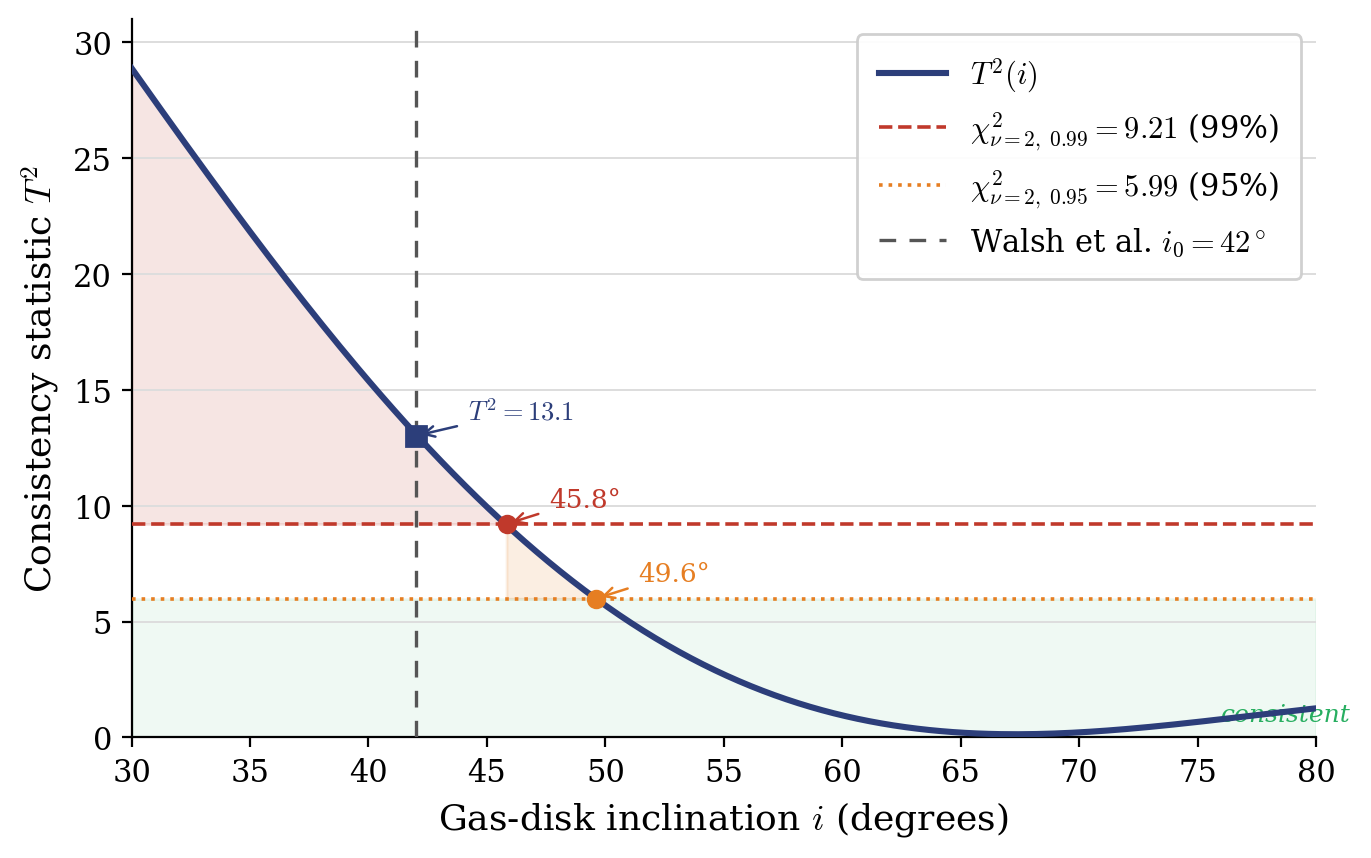
The result is quite striking. The tension falls below the $99\%$ rejection threshold once
$$i\gtrsim45.8^\circ,$$
and below the $95\%$ threshold once
$$i\gtrsim49.6^\circ.$$
Thus a correction of only about $4^\circ$ to $8^\circ$ relative to the fiducial gas-disk inclination is enough to bring the three mass sectors back into statistical consistency. This is small enough to be physically plausible, since gas disks can be affected by non-circular motion, warping, turbulent pressure support, and other modelling systematics.

I also checked whether the tension could be removed simply by increasing the quoted gas-sector uncertainty. Holding the inclination fixed at
$$i_0=42^\circ,$$
the statistic falls below the $99\%$ threshold only when
$$\sigma_{\rm gas}\approx0.92\times10^9M_\odot,$$
and below the $95\%$ threshold only when
$$\sigma_{\rm gas}\approx1.18\times10^9M_\odot.$$
These are noticeably larger than the adopted uncertainty
$$\sigma_{\rm gas}=0.75\times10^9M_\odot.$$
So the tension is not most naturally resolved by simply widening the gas error bar. A small inclination correction is a cleaner explanation.
The achievement here is therefore threefold. First, the M87* mass tension is turned from a qualitative statement into a precise covariance-weighted statistic. Second, the disagreement is localised to the gas-kinematic sector rather than spread across all observational methods. Third, the size of the required systematic shift is quantified: a modest change in the gas-disk inclination is enough to restore agreement.
The full chain of reasoning can be summarized as
$$\{M_{\rm EHT},M_{\rm star},M_{\rm gas}\}\longrightarrow\bar{M}\longrightarrow T^2\longrightarrow p\text{-value}\longrightarrow\text{sector diagnosis}.$$
This is the main point of the M87* application. The statistic is not merely a number attached to a discrepancy. It is a diagnostic tool. It tells us how inconsistent the sectors are, which sector is responsible, and how large a systematic correction would be required to restore consistency.
In this sense, M87* provides a useful first demonstration of the framework. The EHT and stellar-dynamical sectors agree very well. The gas-kinematic sector sits low. A small change in the assumed gas-disk inclination is enough to move it back toward the common mass scale. The result is not evidence against the Kerr hypothesis, but rather a clean example of how covariance-based consistency tests can separate genuine inter-sector agreement from sector-specific modelling tension.
